A garment measures 52.5 cm across the chest, while the approved specification requires 52 cm. Is this a defect?
The answer depends on the agreed measurement tolerance. If the permitted deviation is ±1 cm, the garment is acceptable for that measurement. If the tolerance is only ±0.3 cm, the same result falls outside the approved limit.
This simple example illustrates an important issue in garment quality inspection: a measurement difference does not automatically mean a product is defective. Inspectors must determine whether the deviation exceeds the agreed tolerance and whether the measurement was taken correctly.
Why Measurement Tolerances Matter
Garment manufacturing involves cutting, sewing, pressing, washing, and finishing processes. Small dimensional variations can occur even when the factory follows approved production procedures.
A measurement tolerance defines the acceptable difference between the target dimension and the actual measurement.
For example, a shirt with a specified body length of 70 cm and a tolerance of ±1 cm has an acceptable range of 69–71 cm.
Any result outside this range should be recorded as a deviation.
However, the appropriate tolerance depends on the garment design, fabric characteristics, measurement point, and intended fit.
A narrow collar opening may require tighter control than the overall length of a loose-fitting sweatshirt.
Buyers should therefore avoid applying one universal tolerance to every garment measurement.
When Two Inspectors Obtain Different Results
Measurement disputes sometimes arise because the factory and third-party inspector report different dimensions for the same garment.
The difference may not indicate that either party is deliberately reporting incorrect information.
Common causes include inconsistent garment positioning, different measuring points, fabric stretching, and variations in how the measuring tape is applied.
For example, a knitted T-shirt may produce different chest measurements depending on whether the fabric is laid naturally or pulled flat under tension.
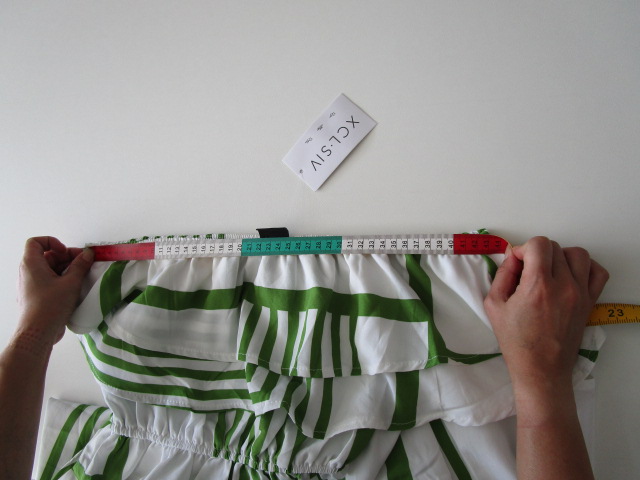
Before declaring a measurement nonconforming, inspectors should confirm the approved measurement method, place the garment on a suitable flat surface, and repeat the measurement where necessary.
When the result remains disputed, photographs showing the measuring tape and reference points can help buyers evaluate the discrepancy.
Understanding Isolated and Repeated Deviations
One garment measuring outside tolerance may represent an isolated manufacturing error.
However, repeated deviations in the same direction can indicate a broader production problem.
Suppose an inspector measures ten jackets in size M and discovers that eight have sleeve lengths approximately 1.5 cm shorter than specified.
This pattern suggests that the problem may be related to cutting patterns, sewing allowances, fabric shrinkage, or production settings rather than random variation.
During apparel quality control, recording individual measurements helps buyers identify such patterns.
Inspection reports should ideally show the specified measurement, actual result, tolerance, and deviation for each checked point.
This information is more useful than simply stating that the garments have incorrect dimensions.
How Measurement Deviations Should Be Classified
Not every dimensional deviation has the same impact on garment quality.
An incorrect waist measurement may significantly affect fit, while a small difference in pocket placement may have a limited effect on usability.
The severity of a measurement defect should be evaluated according to the buyer’s approved classification criteria, product design, and potential effect on the finished garment.
For example:
- A significantly undersized neckline may affect wearability.
- An excessive sleeve-length difference may create an obvious fit problem.
- A small decorative placement deviation may have less practical impact.
- Repeated size deviations may indicate a systematic production issue.
The terms Critical, Major, and Minor should not be assigned automatically based only on which dimension is being measured.
A measurement point can be important without every deviation necessarily being classified as a critical defect.
What Happens When Measurements Exceed Tolerance?
When inspectors identify out-of-tolerance measurements, the next step is to determine the extent and likely cause of the problem.
The supplier may need to review cutting patterns, sewing procedures, fabric shrinkage, or finishing operations.
Depending on the defect, corrective action could involve adjusting production settings, sorting affected garments, or reworking products where technically feasible.
Some dimensional problems cannot be corrected without damaging the garment or compromising its appearance.
For significant deviations, buyers may request additional measurements across different sizes, styles, or production batches.
A pre-shipment inspection can provide independent measurement results before goods are released, but it does not automatically establish that every garment in the shipment meets the specified dimensions.
Making Measurement Results More Reliable
Reliable measurement evaluation starts with an approved specification sheet.
Buyers should provide target dimensions, measurement diagrams, tolerances, and any special instructions for stretch fabrics or washed garments.
The inspection plan should also define how many garments will be measured across the relevant sizes and styles.
For orders with recurring sizing problems, additional measurements may be appropriate.
Where AQL sampling is used for general workmanship inspection, the measurement sampling and acceptance requirements should still be clearly agreed. The same acceptance criteria should not automatically be applied to every measurement point.
Clear specifications and consistent measurement methods reduce unnecessary disputes and support more reliable inspection decisions.
How NBNQC Supports Garment Buyers
NBNQC provides independent garment inspection services across mainland China, including dimensional verification against buyer-approved specifications.
Our inspectors record measurement deviations, identify relevant workmanship concerns, and provide photographic evidence where appropriate.
These findings help international buyers communicate with manufacturers and determine whether corrective action or additional inspection is required.
Accurate garment measurement is not simply about reading a measuring tape. It is about applying the correct method, evaluating results against agreed tolerances, and understanding what deviations mean for the finished product.