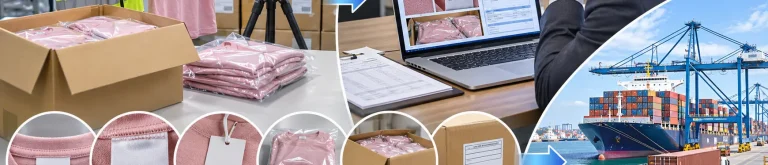
Maintaining consistent garment quality requires more than checking finished products before shipment. For apparel buyers sourcing from China, identifying problems at the right production stage can help prevent costly rework, shipment delays, and customer complaints.
A well-planned inspection schedule allows buyers to monitor production progress, verify workmanship, and address quality concerns before they affect an entire order.
However, not every apparel order requires the same inspection arrangement. The appropriate timing depends on production complexity, supplier reliability, order quantity, and potential quality risks.
Why Inspection Timing Matters in Apparel Manufacturing
Garment production involves several interconnected processes, including fabric preparation, cutting, sewing, finishing, labeling, and packing.
Quality problems discovered early may be relatively easy to correct. Once thousands of garments have been completed, the same problems can become expensive and time-consuming to resolve.
For example, incorrect fabric colors identified before cutting may be addressed through material replacement. If the problem is discovered after sewing and packing, corrective action becomes considerably more difficult.
A structured garment quality inspection plan helps buyers identify issues at appropriate stages rather than relying entirely on final inspection results.
1. Initial Production Check (IPC): Before Mass Production Progresses
An Initial Production Check is generally conducted when production is beginning, typically within the first 0–20% of the production process.
The objective is to verify that the factory understands the approved specifications and has prepared the correct materials and production arrangements.
Key inspection points include:
- Fabric type, color, and material consistency.
- Approved samples and technical specifications.
- Cutting accuracy and pattern requirements.
- Labels, trims, and accessories.
- Initial workmanship and production readiness.
IPC is particularly useful for new suppliers, complex garment designs, unfamiliar materials, or orders involving strict technical requirements.
Identifying discrepancies at this stage allows factories to implement corrections before large-scale production continues.
2. During Production Inspection (DPI): Monitor Bulk Quality
A during production inspection is commonly arranged when approximately 20–80% of production has been completed.
At this stage, inspectors can evaluate finished and semi-finished garments while checking whether production is progressing according to schedule.
Important checks include sewing workmanship, garment measurements, fabric appearance, color consistency, trims, and production quantities.
For example, recurring seam puckering or measurement deviations may indicate problems with sewing methods, equipment settings, or cutting accuracy.
Identifying these issues during production allows buyers to request corrective action before the remaining garments are manufactured.
DPI is especially valuable for large orders, multiple styles, tight delivery schedules, and suppliers with previous quality problems.
3. Pre-Shipment Inspection (PSI): Verify Finished Goods
A Pre-Shipment Inspection is typically conducted when at least 80% of the order has been completed and the goods are sufficiently packed for inspection.
The purpose is to assess whether finished garments meet the buyer’s requirements before shipment.
Inspectors usually verify:
- Order quantities, styles, colors, and sizes.
- Fabric appearance and workmanship.
- Garment measurements against approved tolerances.
- Printing, embroidery, and functional trims.
- Labels, barcodes, packing, and shipping marks.
- Required on-site tests and functional checks.
Random sampling is commonly performed according to ISO 2859-1 or ANSI/ASQ Z1.4, using the inspection level and AQL limits agreed with the buyer.
A commonly used inspection plan is General Inspection Level II with AQL limits of Critical 0, Major 2.5, and Minor 4.0.
PSI provides an independent assessment of sampled finished goods, helping buyers make informed shipment decisions.
4. When Should Buyers Arrange Multiple Inspections?
Not every garment order requires IPC, DPI, and PSI together.
For established suppliers producing familiar styles with consistent quality records, a single PSI may provide an appropriate final quality checkpoint.
However, additional inspections should be considered when:
- Working with a new or unverified manufacturer.
- Producing complicated or high-value garments.
- Managing large orders with multiple styles.
- Introducing new fabrics, trims, or construction methods.
- Addressing recurring quality problems.
- Operating under strict delivery deadlines.
For higher-risk orders, combining DPI with pre-shipment inspection provides opportunities to identify problems during manufacturing and verify finished goods before dispatch.
Buyers requiring individual examination of every garment may also consider Full Inspection rather than relying solely on random sampling.
5. How to Prepare an Effective Inspection Plan
Before production begins, buyers should provide the inspection company with relevant documents, including purchase orders, approved samples, technical packs, size charts, and packaging instructions.
Inspection requirements should clearly define measurement tolerances, workmanship standards, defect classifications, and any special testing procedures.
Buyers should also coordinate inspection dates with the factory and allow sufficient time for corrective action when necessary.
A clear inspection plan reduces misunderstandings and helps inspectors focus on the most important quality risks.
Conclusion
Effective garment inspection planning depends on identifying the right inspection stages for each order.
IPC helps verify production readiness, DPI monitors manufacturing quality, and PSI assesses finished goods before shipment.
By selecting inspection services according to supplier performance, product complexity, and order requirements, apparel buyers can improve quality visibility and reduce avoidable shipment risks.
NBNQC provides independent apparel inspection services across mainland China, helping international buyers monitor production, verify product quality, and make informed shipment decisions.