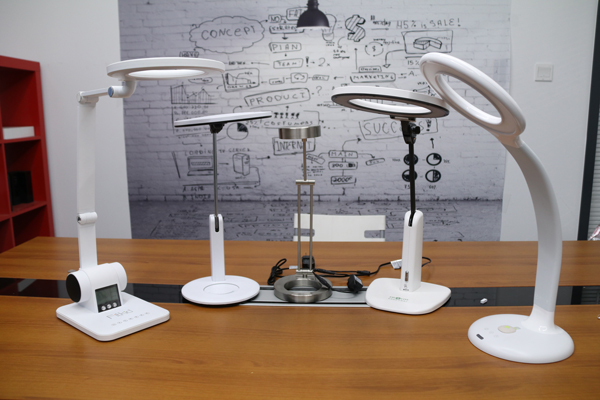
Eye-friendly LED lights are widely used in homes, offices, classrooms, and study areas. These products are often marketed as providing comfortable illumination through reduced flicker, controlled glare, and suitable light distribution.
However, claims such as “eye protection” or “flicker-free” should be supported by measurable performance requirements rather than marketing descriptions alone.
For buyers sourcing LED lighting products from China, the following seven inspection points help evaluate product quality, safety, and consistency before shipment.
1. Verify Illuminance and Light Uniformity
Adequate illumination is essential for reading, studying, and other visual tasks.
Inspectors should verify whether the product provides the specified illuminance under defined installation and operating conditions.
Important checks include:
- Illuminance at designated measurement points
- Uniformity across the illuminated area
- Consistency between brightness settings
- Light distribution and coverage
- Abnormal dark spots or uneven illumination
Illuminance is measured in lux, while uniformity depends on the distribution of light across the target surface.
During LED lighting quality inspection, inspectors should compare measurements with approved specifications and applicable performance requirements.
2. Evaluate Flicker and Light Modulation
LED lights may exhibit fluctuations in light output caused by their drivers, dimming systems, or power supply conditions.
Excessive temporal light modulation can produce visible flicker or stroboscopic effects.
Buyers should establish measurable requirements using suitable parameters, such as PstLM or SVM, where applicable.
Inspectors should check for obvious flicker and abnormal operation at different brightness settings.
However, smartphone camera observations cannot reliably establish compliance with quantitative flicker requirements.
Accurate measurements require suitable instruments and standardized testing procedures.
3. Check Glare and Visual Comfort
Glare can reduce visual comfort, particularly when bright LED sources are directly visible.
Inspectors should examine the diffuser, reflector, optical cover, and overall light distribution.
Common problems include:
- Exposed high-brightness LED points
- Uneven diffuser surfaces
- Excessive direct glare
- Poorly positioned light sources
- Inconsistent optical components
Glare evaluation depends on the intended installation and application.
Formal glare measurements may require specialized equipment and defined test arrangements.
4. Verify Color Temperature and Color Rendering
Correlated color temperature (CCT) influences the appearance of emitted light, while color rendering describes how accurately objects appear under illumination.
Inspectors should verify that actual performance matches the manufacturer’s specifications.
Important parameters include:
- Correlated color temperature
- Color rendering index (CRI)
- Consistency between production units
- Adjustable color temperature functions
- Color stability during operation
A warmer color temperature is not automatically safer or more suitable for every application.
Buyers should select appropriate lighting characteristics based on intended use and applicable requirements.
5. Review Blue Light and Photobiological Safety
Blue light safety is an important consideration for LED lighting products, but it should be evaluated using recognized photobiological safety methods.
Relevant standards include IEC 62471 and IEC 62471-7:2023, depending on the applicable product and assessment requirements.
These standards address potential optical radiation hazards under defined exposure conditions.
During lighting product inspection, inspectors can review available laboratory reports, product identification, and relevant technical documentation.
Routine on-site inspections cannot independently establish blue light hazard classifications without suitable specialized equipment.
Buyers should also avoid unsupported claims that a lighting product prevents myopia or eliminates eye strain.
6. Inspect Electrical Safety and Product Construction
Electrical safety and construction quality are essential for LED lighting products.
Common inspection points include:
- Housing and diffuser assembly
- Power cord and connector condition
- Switch and dimming functions
- Stability of mounting components
- Abnormal heating during operation
- Product labels and electrical ratings
IEC 60598-1 provides general safety requirements for luminaires, while applicable particular standards depend on the product type.
Electrical safety testing may include insulation resistance, dielectric strength, and protective earthing checks where required.
Such tests should be performed by qualified personnel using appropriate equipment and procedures.
7. Verify Packaging, Labeling, and Shipment Readiness
Before shipment, inspectors should confirm that finished products match approved purchase and packaging requirements.
Typical checks include:
- Correct model and product specifications
- Rated voltage and power markings
- Required safety warnings
- Instruction manuals and accessories
- Barcode and carton information
- Packaging protection and carton condition
During pre-shipment inspection, sampling may follow ISO 2859-1 or ANSI/ASQ Z1.4 using agreed inspection levels and AQL values.
Defects should be classified according to product safety, functionality, appearance, and buyer requirements.
Conclusion
Effective eye-friendly LED light inspection requires more than checking brightness and appearance. Buyers should establish measurable requirements for illuminance, flicker, glare, color performance, photobiological safety, and electrical construction.
NBNQC provides independent inspection services across mainland China, helping international buyers verify finished LED lighting products against approved specifications before shipment.
Combining routine product inspection with appropriate laboratory testing helps buyers identify manufacturing defects and evaluate documented safety and performance claims.