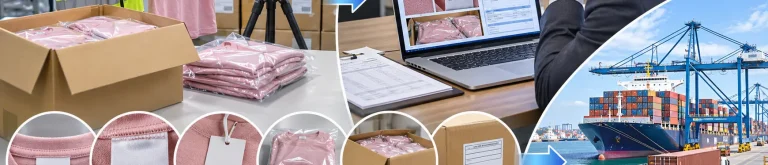
Customized promotional products play an important role in marketing campaigns, corporate events, trade shows, and brand promotion activities. Items such as printed T-shirts, branded mugs, tote bags, promotional gifts, stationery, and electronic accessories help businesses increase brand visibility and strengthen customer engagement.
However, these products often involve customized designs, logos, colors, printing methods, and packaging requirements. Even small inconsistencies can affect brand presentation, particularly when thousands of items are distributed during a scheduled marketing campaign.
For importers sourcing promotional merchandise from China, a structured inspection process is essential to verify product quality, customization accuracy, and order completeness before shipment.

1. Verify Logos, Artwork, and Customization Details
Branding accuracy is one of the most important aspects of promotional product inspection. Unlike standard consumer goods, customized merchandise must reproduce the buyer’s approved artwork accurately.
Inspectors should compare bulk production against approved samples, artwork files, and customization specifications.
Key checkpoints include:
- Logo position, dimensions, and alignment.
- Printing colors and consistency with approved artwork.
- Font style, spelling, and text accuracy.
- Embroidery quality, density, and stitching appearance.
- Engraving depth, clarity, and positioning.
- Surface printing adhesion and resistance to rubbing.
For products with multiple printing locations or different logo versions, each variation should be checked separately.
A common problem is that suppliers use an outdated artwork file or apply different printing settings during production. Buyers should provide clearly approved reference files before manufacturing begins.
2. Check Product Appearance and Material Quality
Promotional products cover a wide range of categories, so inspection requirements should be adapted to each product type.
For textile promotional items, such as T-shirts and tote bags, inspectors should examine fabric quality, stitching, seams, dimensions, color consistency, and finishing.
For mugs, drinkware, and household gifts, attention should be given to surface defects, cracks, scratches, coating quality, and structural integrity.
Electronic promotional products, including USB accessories and small gadgets, require additional functional checks. These may include power-on tests, charging performance, button operation, indicator lights, and basic operating functions.
Other important checkpoints include:
- Material consistency with approved specifications.
- Overall appearance and finishing quality.
- Dimensional accuracy and product weight.
- Assembly quality and component completeness.
- Sharp edges, loose parts, and potential safety hazards.
When products are intended for specific markets, applicable safety and regulatory requirements should also be considered. Laboratory testing may be necessary for certain materials or product categories.
3. Evaluate Printing Durability and Functional Performance
A promotional item may look attractive when first inspected but lose its appearance after limited use. Printing durability is therefore an important consideration for customized merchandise.
Depending on the printing method and product material, suitable on-site tests may include:
- Rub test: Check whether printed designs or surface coatings transfer or fade when rubbed.
- Adhesion test: Evaluate whether stickers, labels, and printed surfaces remain attached.
- Wash test: Assess printing and color stability on applicable textile products.
- Scratch test: Check the resistance of coated or printed surfaces to scratching.
- Functional test: Verify whether the product performs its intended function.
- Assembly test: Confirm that components fit together correctly and operate as expected.
Testing methods should reflect the product’s intended use and agreed specifications. Acceptance criteria should be confirmed before inspection to avoid disagreements between buyers and suppliers.
4. Verify Order Quantities and Product Assortments
Promotional campaigns often involve multiple product types, colors, designs, and customized versions within a single purchase order.
For example, an event package may contain T-shirts in different sizes, several colors of tote bags, branded mugs, and assorted stationery.
Inspectors should verify:
- Total finished quantity against the purchase order.
- Correct product models and specifications.
- Color and size assortments.
- Correct logo versions and artwork.
- Accessory and gift-set completeness.
- Individual product packaging and carton quantities.
Particular attention should be paid to mixed cartons and assortment packing. Incorrect quantities or missing items can create distribution problems even when the individual products pass inspection.
Buyers should provide a clear packing list and assortment breakdown before the inspection takes place.
5. Examine Packaging and Campaign Delivery Requirements
Packaging is another important consideration for promotional merchandise, particularly when products are distributed at exhibitions, corporate events, or seasonal campaigns.
Inspectors should check whether individual products are properly protected and whether packaging matches the buyer’s requirements.
Typical checkpoints include:
- Individual bags, boxes, and protective materials.
- Product labels, barcodes, and promotional inserts.
- Correct assortment and carton markings.
- Carton condition and packing strength.
- Quantity per carton and shipping marks.
- Protection against moisture, scratches, and transportation damage.
For gift sets, all items should be checked for completeness and correct arrangement.
If promotional products are packed into separate event kits, the packing instructions should be clearly documented and verified during inspection.
6. Schedule Inspections to Reduce Delivery Risks
Promotional merchandise is often linked to fixed marketing schedules. Delayed shipments may result in missed exhibitions, product launches, seasonal promotions, or corporate events.
Inspection should therefore be integrated into the production schedule rather than arranged only when the supplier announces that everything is finished.
Initial Production Check (IPC) helps verify initial production quality and identify problems with materials, artwork, or production arrangements.
During Production Inspection (DPI) allows buyers to identify recurring defects while manufacturing is still underway.
Pre-Shipment Inspection (PSI) is normally arranged when at least 80% of the order is completed. It verifies finished goods, workmanship, customization, quantities, and packaging before shipment.
For urgent campaigns or high-risk orders, buyers may also consider Full Inspection (100%) when sampling inspection does not provide sufficient assurance.
Allowing sufficient time for inspection, factory corrections, and possible re-inspection is an important part of production deadline risk management.
7. Work with an Independent Inspection Company
Managing customized promotional merchandise requires attention to both product quality and brand presentation. Buyers should establish clear inspection requirements before production and use approved samples and artwork as reference standards.
A professional third-party inspection company can provide independent verification of finished products, identify defects, document inspection findings, and help buyers make informed shipment decisions.
NBNQC provides promotional product inspection services across mainland China, covering textiles, bags, household gifts, electronics, stationery, toys, and other customized merchandise.
Our inspection scope can include custom logo and artwork verification, workmanship checks, functional tests, quantity verification, and packaging inspection according to individual buyer requirements.
A practical promotional merchandise inspection checklist helps ensure that customization details, product specifications, and packing requirements are properly verified before shipment.
By identifying problems before goods leave the factory, importers can reduce avoidable quality disputes, protect brand reputation, and improve the reliability of promotional campaigns.