Outdoor lighting fixtures must operate reliably in environments exposed to rain, dust, humidity, temperature changes, and other outdoor conditions. Effective quality control therefore needs to cover more than appearance and basic functionality. Waterproof construction, electrical safety, assembly quality, performance, and packaging all require verification before shipment.
For importers and brands, a structured pre-shipment inspection provides an independent assessment of finished outdoor lighting products against specifications, approved samples, inspection criteria, and packaging requirements. The objective is to identify defects and non-conformities before the products leave the factory.
Understanding IP Ratings for Outdoor Lighting
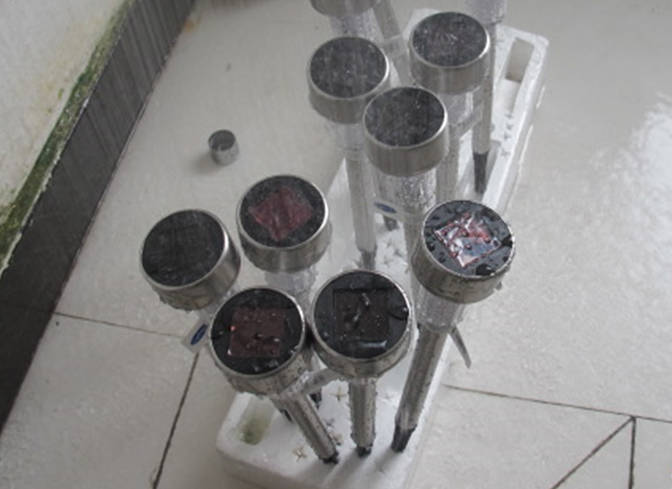
Ingress Protection (IP) ratings indicate the level of protection an enclosure provides against solid particles and water. The rating normally consists of two digits.
The first digit represents protection against solid objects and dust, while the second represents protection against water. Common ratings for outdoor lighting include:
- IP44: Protection against solid objects larger than 1 mm and splashing water.
- IP65: Dust-tight construction with protection against water jets.
- IP66: Dust-tight construction with increased protection against powerful water jets.
- IP67: Dust-tight construction with protection against temporary immersion under specified conditions.
- IP68: Protection against continuous immersion according to conditions defined by the manufacturer.
A higher IP rating does not automatically mean a product is suitable for every outdoor application. The required protection depends on installation location, exposure conditions, product design, and applicable specifications.
During product inspection, inspectors should therefore verify not only the IP marking but also whether the actual construction, sealing components, assembly, and documentation are consistent with the approved product requirements.
Waterproof Construction and Sealing Checks
Outdoor lighting commonly relies on gaskets, O-rings, sealant, cable glands, covers, and tightly assembled housings to prevent water ingress. Small manufacturing deviations can compromise the intended protection.
Inspection should check critical areas such as:
- Gaskets correctly installed without deformation or damage
- Housing covers properly fitted and tightened
- Cable glands securely assembled
- Sealant applied continuously where required
- No visible gaps around lenses, joints, switches, or connectors
- Drainage or ventilation structures installed according to the approved design
Products should also be checked against approved samples, technical specifications, drawings, or other reference documents when available.
An on-site water spray or immersion check may be performed when requested and when suitable equipment and test conditions are available. However, a factory product inspection should not automatically be treated as a substitute for a formal laboratory IP test conducted according to the applicable standard.
Appearance and Workmanship Inspection
Water resistance alone does not determine product quality. Outdoor fixtures may also have defects involving housings, lenses, coatings, brackets, screws, wiring, connectors, or decorative surfaces.
During electrical and electronics quality control, sampled products can be inspected for scratches, dents, cracks, poor coating, corrosion, loose components, inconsistent assembly, excessive gaps, damaged wires, exposed conductors, missing screws, and other workmanship defects.
Color, dimensions, product model, labels, logos, and accessories should also be compared with approved requirements.
For batch inspection, defects can be classified as critical, major, or minor according to the buyer’s agreed acceptance criteria and sampling plan.
Functional and Performance Testing
Every sampled outdoor light should operate according to its intended functions. Depending on the product, inspection may include:
- Power-on and illumination checks
- Switch and control operation
- LED color and brightness consistency
- Dimming functions
- Motion or light sensor operation
- Timer or remote-control functions
- Charging and battery operation for solar lights
- Product power consumption or voltage checks when required
Multiple units should be compared where practical because variation between products can reveal assembly or component consistency problems that may not be obvious when checking a single unit.
Electrical Safety Checks
Electrical products can present greater risks than ordinary consumer goods when assembly or insulation is defective. Relevant on-site tests should therefore be included according to the product specification and inspection requirements.
Depending on available equipment and the product design, checks may include earth continuity, insulation resistance, dielectric strength, polarity, input power, voltage, and other electrical measurements.
Inspectors should also examine cables, plugs, terminals, strain relief, internal wiring where accessible, and safety markings.
These checks do not replace certification or laboratory compliance testing. Their purpose is to identify production-related deviations and obvious safety risks before shipment.
Labels, Ratings and Documentation
Outdoor lighting normally carries technical information such as rated voltage, wattage, model number, IP rating, safety symbols, and manufacturer or importer details.
Inspection should confirm that required information is present, legible, correctly positioned, and consistent across the product, packaging, user manual, and approved specification.
Incorrect ratings or labels can become a serious issue even when the physical product itself functions correctly, particularly for goods subject to market-specific regulatory requirements.
Packaging Inspection
Outdoor lighting fixtures often contain glass, lenses, brackets, cables, and other components susceptible to transport damage. Packaging therefore forms an important part of final quality control.
Inspectors should verify inner protection, carton condition, product quantity, accessories, manuals, barcodes, shipping marks, carton dimensions, and packing configuration. Drop testing or other packaging checks can also be conducted when included in the buyer’s inspection specification.
Reducing Quality Risks Before Shipment
Outdoor lighting quality depends on the interaction between waterproof construction, electrical components, workmanship, performance, labeling, and packaging. A product may have the correct IP marking but still contain poorly fitted seals, defective wiring, cosmetic defects, inconsistent LEDs, or inadequate packaging.
A systematic pre-shipment inspection helps buyers identify these problems while the goods are still at the factory. By combining visual inspection, functional testing, relevant electrical checks, waterproof-related verification, and packaging assessment, buyers gain clearer information for shipment approval, rework, or corrective action.